Vintage Grunge Tags Positive Quotes
First Impressions: Grit, Warmth, and Quiet Confidence
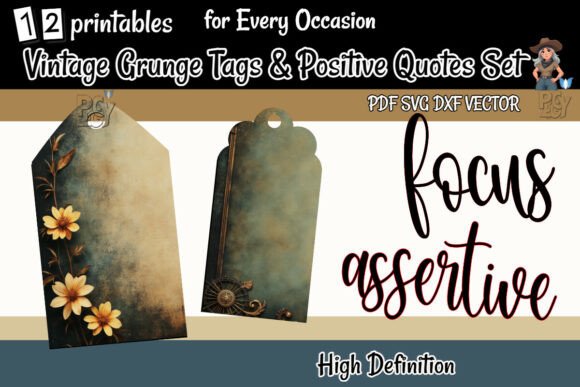
Opening Vintage Grunge Tags Positive Quotes feels like flipping through a well-loved notebook—slightly weathered, intentionally imperfect, and full of quiet sincerity. These six digital backgrounds aren’t loud or flashy; they’re layered with subtle texture, soft edges, and thoughtful negative space. The grunge treatment isn’t chaotic—it’s controlled: faint paper grain, gentle ink bleed, and just enough imperfection to feel handmade, not distressed for effect. Each tag shape—oval, banner, shield, rectangle, circle, and scalloped label—frames its positive phrase (“Breathe,” “You’ve Got This,” “Made With Love”) like a small, wearable affirmation. As an embroidery designer who’s stitched hundreds of quote-based pieces, I immediately saw where this set lands: not on trend-chasing tees, but on pieces people keep—tote bags for farmers’ markets, linen aprons for bakers, baby onesies for mindful parents, and pillow covers for calm bedrooms.
A Real Project Test: Embroidering a Linen Tote for a Local Bakery
Last week, I used one of the oval tags from Vintage Grunge Tags Positive Quotes on a natural linen tote for a neighborhood sourdough bakery. The goal wasn’t novelty—it was warmth, authenticity, and quiet professionalism. I chose the “Rise & Shine” variation, resized it to fit a 4×4 hoop, and stitched it on the lower front corner with matte cotton thread in warm taupe and charcoal. The result? A design that looked *embroidered*, not printed. The grunge texture translated beautifully into stitch: subtle satin-stitch outlines softened the edges, while open fill areas let the linen breathe. Customers didn’t say “cool font”—they said, “I love how soft it feels,” and “It looks like someone made this just for us.” That’s the power of this set: it supports storytelling, not shouting.
Where It Shines (and Where It Needs Thought)
Vintage Grunge Tags Positive Quotes works exceptionally well for:
- Custom apparel on medium-weight fabrics—especially sweatshirts, denim jackets, and cotton canvas totes;
- Baby embroidery on organic cotton onesies or burp cloths, where softness and sentiment matter more than sharp detail;
- Embroidered patches for craft fairs or Etsy listings—its shapes lend themselves naturally to cut-and-sew applique;
- Holiday embroidery on tea towels or kitchen linens, where “Joy,” “Gather,” or “Home” land with grounded sincerity;
- Small shop product branding, especially for makers whose aesthetic leans rustic, slow-made, or botanical.
But—and this is critical—it needs thoughtful placement. On thin or stretchy fabric (like lightweight jersey or rayon challis), the open fill areas can shift or pucker without proper stabilizer. On dark fabric, fine details may vanish unless you adjust thread contrast deliberately—test those phrases in black *and* white mockups before finalizing. And avoid dense stitching in tight corners: the scalloped tag, for example, has delicate curves that demand a steady stabilizer base and slower machine speed. Curved surfaces—caps, curved pillow seams, or baby hats—require repositioning the design to avoid distortion. This isn’t a “drop-in-and-stitch” file. It’s a design asset that rewards attention.
What It Adds to Your Finished Product—Beyond Aesthetics
Using Vintage Grunge Tags Positive Quotes doesn’t just add decoration—it adds dimension to perception. Handmade products with this design read as more intentional, more curated. Customers associate that tactile, slightly imperfect texture with care—not haste. For Etsy sellers, it lifts perceived value: a $28 linen towel with “Breathe” stitched in muted sage reads as boutique-worthy, not generic. For craft business owners building brand consistency, these tags offer visual cohesion across product lines—same mood, different phrases—without repeating motifs. And for personalized gifts? The emotional resonance is immediate. A new mom receiving a onesie with “Hold On To Joy” stitched in soft grey thread doesn’t see a graphic. She feels seen.
Practical Designer Notes Before You Stitch
Before using Vintage Grunge Tags Positive Quotes in your next embroidery project—or listing it as part of a commercial offering—here’s what I do every time:
- Test on scrap fabric first, using the exact stabilizer and thread you’ll use in production;
- Check thread color contrast—especially for light text on light fabric or dark text on dark fabric;
- Review stitch density: look for any overly dense fill areas that might cause stiffness or puckering on drapey fabrics;
- Confirm hoop size compatibility—some variations may need slight resizing to fit standard hoops without losing legibility;
- Inspect small details under magnification: tiny serifs, inner curves, and connecting strokes must hold up at your intended size;
- Test in black-and-white mockups to ensure readability and balance without color bias;
- Use appropriate stabilizer: tear-away for stable wovens, cut-away for knits, and mesh for lightweight linens;
- Verify licensing—if you plan to sell finished embroidered items or bundle this as part of a digital product, confirm whether the license permits commercial embroidery use and resale of physical goods.
This set belongs in the Crafts category because it’s built for making—not just displaying. As Graphics, it bridges digital and tactile worlds cleanly. But its real strength lies in how it serves the maker: quietly, respectfully, and with consistent integrity across tote bag design, sweatshirt embroidery, baby embroidery, holiday embroidery, and commercial embroidery projects.
Final Thought: Less Is More—When It’s Done Right
Vintage Grunge Tags Positive Quotes won’t dominate a garment. It won’t scream for attention. What it does—beautifully—is invite pause. In a world of oversaturated designs and algorithm-driven trends, this set offers something rare: visual breathing room with emotional weight. Whether you’re stitching for your own craft business, prepping for a holiday market, or creating a personalized gift, it gives your work a grounded, human voice. Just remember: its charm lives in the details, the texture, and the intention behind each stitch. Treat it like the thoughtful design asset it is—and your finished product will reflect that care.